


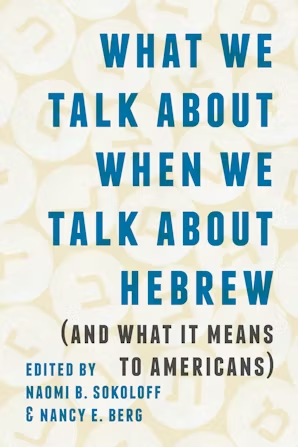

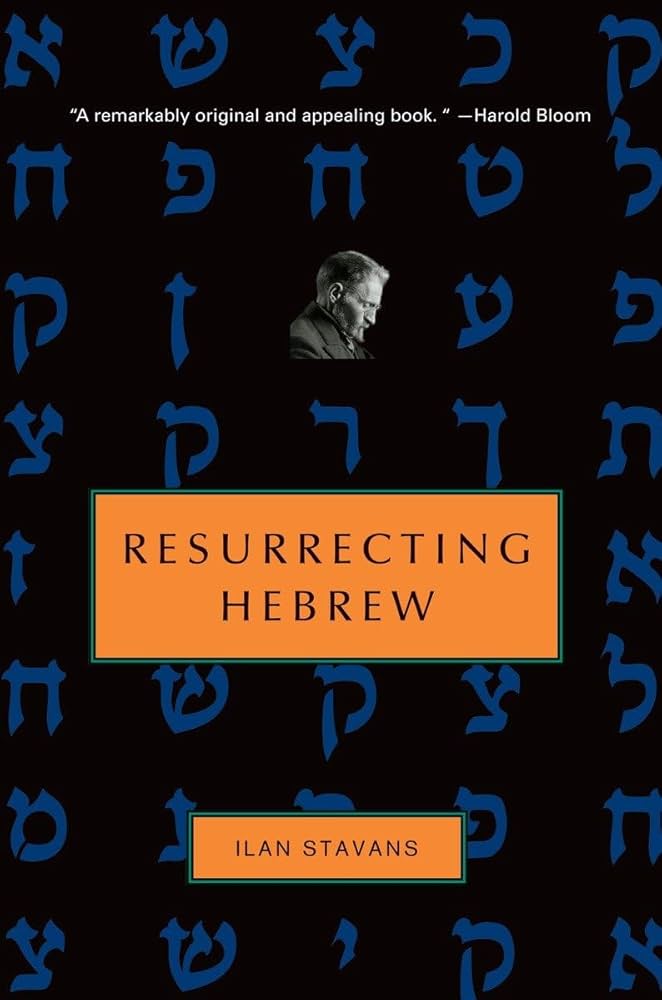

The following collection of books offers readers a rich and multifaceted entry point into the history and meaning of Modern Hebrew, tracing its transformation from an ancient literary and liturgical language to a vibrant, spoken vernacular. Together, these works illuminate the linguistic, cultural, and social forces that shaped Hebrew’s revival, its adaptation to new contexts, and its role in Jewish identity today. By bringing together scholarship on language history, sociolinguistics, pedagogy, and cultural life, this bibliography provides a foundation for understanding how Modern Hebrew emerged, evolved, and continues to function as both a unifying symbol and a dynamic medium of everyday expression.
This volume addresses themes relevant to the history, structure, or social life of Hebrew, providing accessible entry points for students and interested readers. It is included here for its relevance to understanding how Hebrew has been studied, taught, and discussed in modern contexts.
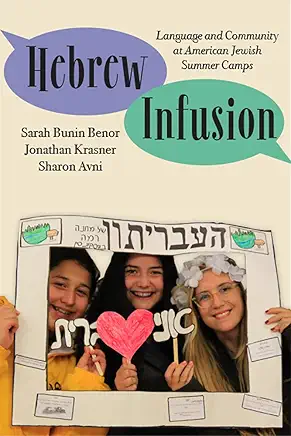
A sociolinguistic portrait of Hebrew in immersive educational spaces, with attention to practices, identities, and community-building. It sheds light on the American context, including institutions, communities, and ideologies that shape Hebrew use.
This volume addresses themes relevant to the history, structure, or social life of Hebrew, providing accessible entry points for students and interested readers. It is included here for its relevance to understanding how Hebrew has been studied, taught, and discussed in modern contexts.
This volume addresses themes relevant to the history, structure, or social life of Hebrew, providing accessible entry points for students and interested readers. It is included here for its relevance to understanding how Hebrew has been studied, taught, and discussed in modern contexts.
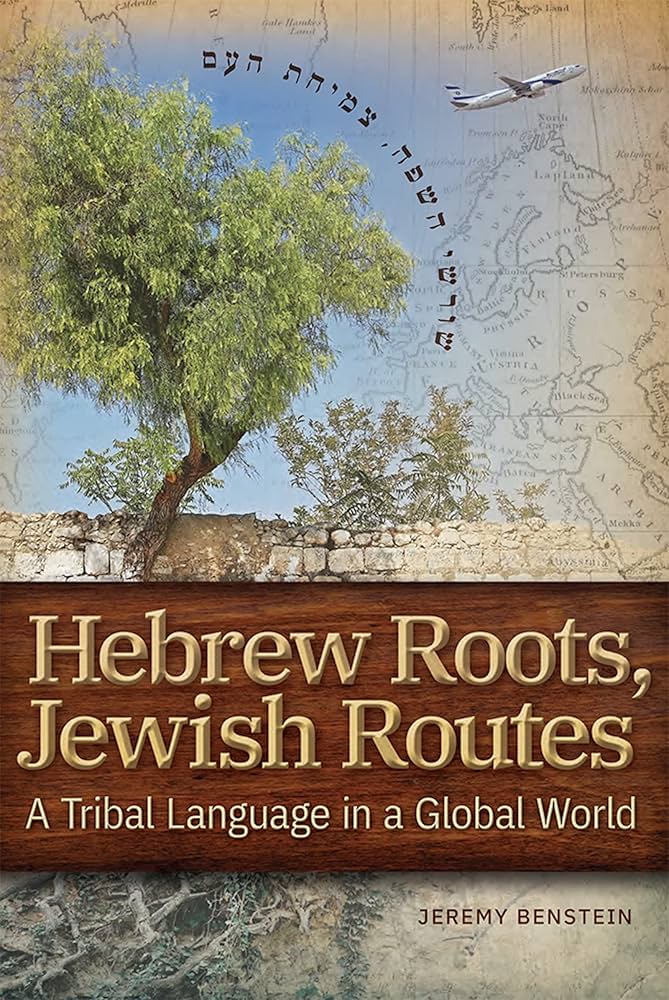
This work focuses on contact-driven change and the dynamics of Hebrew in multilingual settings, highlighting borrowing, innovation, and standardization. It is included here for its relevance to understanding how Hebrew has been studied, taught, and discussed in modern contexts.
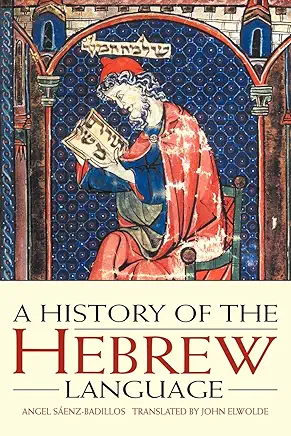
A concise historical overview of Hebrew across periods, designed for general readers and survey courses. It is included here for its relevance to understanding how Hebrew has been studied, taught, and discussed in modern contexts.
This volume addresses themes relevant to the history, structure, or social life of Hebrew, providing accessible entry points for students and interested readers. It is included here for its relevance to understanding how Hebrew has been studied, taught, and discussed in modern contexts.
This volume addresses themes relevant to the history, structure, or social life of Hebrew, providing accessible entry points for students and interested readers. It is included here for its relevance to understanding how Hebrew has been studied, taught, and discussed in modern contexts.
This volume addresses themes relevant to the history, structure, or social life of Hebrew, providing accessible entry points for students and interested readers. It sheds light on the American context, including institutions, communities, and ideologies that shape Hebrew use.
This volume addresses themes relevant to the history, structure, or social life of Hebrew, providing accessible entry points for students and interested readers. It is included here for its relevance to understanding how Hebrew has been studied, taught, and discussed in modern contexts.
This volume addresses themes relevant to the history, structure, or social life of Hebrew, providing accessible entry points for students and interested readers. It sheds light on the American context, including institutions, communities, and ideologies that shape Hebrew use.
This volume addresses themes relevant to the history, structure, or social life of Hebrew, providing accessible entry points for students and interested readers. It is included here for its relevance to understanding how Hebrew has been studied, taught, and discussed in modern contexts.
This volume addresses themes relevant to the history, structure, or social life of Hebrew, providing accessible entry points for students and interested readers. It is included here for its relevance to understanding how Hebrew has been studied, taught, and discussed in modern contexts.
This work focuses on contact-driven change and the dynamics of Hebrew in multilingual settings, highlighting borrowing, innovation, and standardization. It is included here for its relevance to understanding how Hebrew has been studied, taught, and discussed in modern contexts.
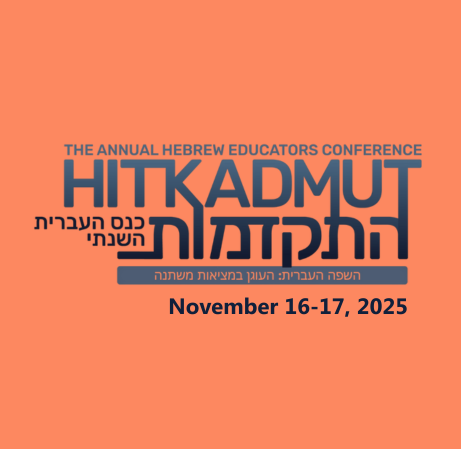
Join Hebrew teachers, Hebrew leaders, and other school leaders for an intensive, virtual conference November 16-17, 11:00 am – 4:00 pm EDT.
Click here for more information and to register
[ninja_form id=57]
[ninja_form id=55]
[ninja_form id=56]
[ninja_form id=9]
[ninja_form id=3]
[ninja_form id=8]
[ninja_form id=5]
[ninja_form id=29]
[ninja_form id=30]
[ninja_form id=27]
[ninja_form id=28]
[ninja_form id=26]
[ninja_form id=]
[ninja_form id=14]
[ninja_form id=4]
[ninja_form id=3]
[ninja_form id=9]
[ninja_form id=8]
[ninja_form id=7]
[ninja_form id=6]
[ninja_form id=5]
[ninja_form id=4]
[ninja_form id=3]
[ninja_form id=2]
[ninja_form id=11]
[ninja_form id=9]
Adina Kanefield is the Chief Executive Officer of the National Library of Israel USA, leading efforts to build support through strategic partnerships, dynamic programming, and community outreach across North America.
Previously, Adina founded a consulting practice focused on strategic growth and resource development, serving as a lead consultant for Hebrew at the Center. She has held leadership roles at the Edlavitch DC Jewish Community Center, the Milton Gottesman Jewish Day School, and the Center for Israel Studies at American University, and earlier practiced regulatory and employment law.
A graduate of The George Washington University School of Law, she also holds bachelor’s and master’s degrees, summa cum laude, from Emory University. Adina lives in Washington, D.C., and serves on Hebrew at the Center’s Board Development Task Force.
Adina lives in Washington, D.C., and is active in Jewish communal life. She serves on the Board Development Task Force for Hebrew at the Center and is a frequent presenter on the intersection of Jewish heritage, cultural preservation, and the mission of the National Library of Israel.
Sanford “Sandy” Cardin
Director
Sanford “Sandy” Cardin is the founder of Global Jewry. A graduate of Harvard University, Sandy is a member of the bar of DC, Florida, Maryland, and the United States Supreme Court, as well
as the Senior Consultant for Philanthropy and Impact at Cresset Capital.
After a short stint practicing law, Sandy shifted into the NGO world. He started as the Mid-Atlantic Director of the Jerusalem Foundation before moving to Tulsa, OK in 1994 to become the first executive director, then first president, of the Charles and Lynn Schusterman Family
Foundation.
Sandy spent 25 years guiding the CLSFF before leaving to become the CEO of Our Common Destiny, a global effort to
bridge the widening gap between the Jews in Israel and those living elsewhere.
Sandy has served on many Jewish boards (including as chair of the board or Leading Edge) and is currently involved in the JCC Association of North America. He has also held leadership posts at the Council on Foundations and National Center for Family Philanthropy.
Sandy lives with his wife, Melody, in Queenstown, MD.
Walter A. Winshall
Director
Walter A. Winshall is a founding member of the board of Hebrew at the Center. He is a Principal in Collaborative Seed and Growth Partners, LLC, an investment firm specializing in the commercialization of early-stage technology. He is also a director at a number of early-stage companies. In addition to HATC, he is a board member of the National Yiddish Book Center and MIT Hillel. He was a founding board member of JCDS, Boston’s Jewish Community Day School and the Institute for the Advancement of Hebrew.
He graduated from MIT in electrical engineering and from Harvard Law School. Walt lives in Weston, Massachusetts with his wife, Arnee, chair of the Hebrew at the Center Board.
Walt serves on the Finance Committee and the Advocacy & Strategic Task Force Committee.
Daniel Serfaty
Director
Daniel Serfaty is currently Chair of Aptima. As Aptima’s Founder and CEO, Daniel Serfaty has led Aptima to become the premier Human Performance Engineering business in the world. His work optimizes the integration of humans with intelligent technologies in defense, healthcare, aerospace, and education. His keynote addresses around the world are encouraging his audiences to imagine a future in which human and artificial intelligences work together in the service of humankind.
Daniel’s interdisciplinary background includes degrees in mathematics, psychology, aerospace engineering, and international business from the Université de Paris, the Technion, Israel Institute of Technology, and University of Connecticut. His doctoral work has pioneered the study of distributed command teams. He is the recipient of the UConn Distinguished Service Award and has been inducted in its Engineering Hall of Fame.
Daniel is the co-Chair of the New England Israeli American Council (IAC), the board of the Friends of the Academy of Hebrew Language and, in addition, serves on the boards of several business and philanthropic organizations in both the United States and Israel, with an eye towards building bridges between these communities. Daniel serves on Hebrew at the Center’s Yom Iyyun Task Force and is co-chair of the Board Development Task Force.
Daniel lives in Cambridge, Massachusetts with his wife Irene.
Todd Sukol
Director
Todd Sukol has worked in and around the nonprofit and philanthropic sector most of his career. At the Mayberg Foundation where he is Executive Director, he oversees the foundation’s strategic philanthropy, grant-making and development of the Jewish Education Innovation Challenge (JEIC) and the Incubator for Emerging Jewish Initiatives (IEJI). In addition, Todd is a founding board member of The Witness Institute. Previously, Todd was president of Do More Mission, a firm that increases nonprofit impact through philanthropic advisory services to high net worth individuals and foundations and management services to small and mid-sized charitable organizations.
Todd received his formal training in Journalism and Public Relations from Pennsylvania State University. He studied
at the University of Manchester in England and completed a two-year Yeshiva program at Machon Shlomo: Alexander and Eva Heiden Torah Institute in Jerusalem, Israel. Sukol graduated from the Executive Master’s program
at the Lilly Family School of Philanthropy at Indiana University where he is currently enrolled in a doctoral program. Todd and his wife Amy (an active Hebrew at the Center volunteer) live in Silver Springs, Maryland. Todd was a member of the Strategic Reset Group, chaired the Strategic Transition and Planning Work Group, and is the current co-chair of the Governance Committee/Committee on Trustees and Board Development Task Force.
Neil Kuttner
Treasurer
Neil Kuttner is the Chief Operations Officer of Cross Shore Capital Management, LLC, a registered investment advisor. He has worked in the financial services industry for forty years, previously at Sanford Bernstein & Co. where he was the CFO. Neil is a CPA and has also taught tax planning at Lehman College. Neil has BA in economics from City College of New York and a master’s degree in business administration from the Wharton School.
Neil lives in Manhattan and has two grown sons, Sam and Matthew, both of whom are involved Jewishly. Neil has long been active in the Jewish community has previously served as treasurer of Camp Ramah in New England, treasurer of the Foundation for Jewish Camp, board chair of the Academy for Jewish Religion, and synagogue president of Park Slope Jewish Center.
Neil views fluency in Hebrew as one of the important building blocks in positive Jewish identity, though his Hebrew language skills do need brushing up. He chairs Hebrew at the Center’s Finance Committee and is looking forward to continuing to contribute both his time and expertise.
Joanne Blauer
Clerk
Joanne Blauer was formerly the Associate Dean, Secretary and Executive Vice Dean of Weill Cornell Medical College and Graduate School of Medical Sciences in New York City.
Joanne has a BA in Philosophy and Religion from Scripps College and a JD from the University of Washington School of Law. She spent her junior year of college at the Hebrew University in Jerusalem. She is the past COO of Hebrew at the Center and a founding board member of the Institute for the Advancement of Hebrew. In addition, Joanne has previously served on the board of Scripps College, the National Association of College and University Attorneys and is an inactive member of the Washington State Bar Association. She lives in New York City and Richmond Shores, Massachusetts. Joanne co- chairs the Governance Committee/Committee on Trustees and serves on the CEO Support and Evaluation Committee (CSEC).
Arnee Winshall
President
co-founded Hebrew at the Center with Dr. Vardit Ringvald and
Sharona Givol. She is Founding Chair of JCDS, Boston’s Jewish Community Day School and sits on the boards of Jewish Interactive and Incubator for Emerging Jewish Initiatives (IEJI).
In addition, Arnee is a member of the JEIC advisory and co-founder of DEEP (a PLC of Developing Embedded Expertise Programs). In the past, she served chair of the RAVSAK board, on the Board of Overseers of Hebrew College, on the Executive Committee of JESNA, as the lay co-chair of the Lippman Kanfer Institute, and on the boards of The Harold Grinspoon Foundation, the JCC’s of Greater Boston, the Foundation for Jewish Camp, JECEI, and the Yiddish Book Center.
Arnee received her undergraduate degree in contrastive linguistics from Boston University and, after serving in the Peace Corps in Thailand, pursued graduate studies in developmental psycholinguistics at the University of Chicago.
Arnee has two adult children and lives in Weston, Massachusetts with her husband, Walt.